

Ontario Construction Report Staff Writer
Ontario’s non-residential building contractors are maintaining a sense of “quiet confidence” for 2026, even as the industry grapples with a polarized market outlook, trade uncertainty, and a persistent struggle for skilled labour.
According to the Ontario Construction Secretariat’s (OCS) annual Contractor Survey, released Thursday (March 5) at the 26th Annual State of the Industry & Outlook Conference in Toronto, the province’s industrial, commercial, and institutional (ICI) sector is displaying remarkable adaptability.
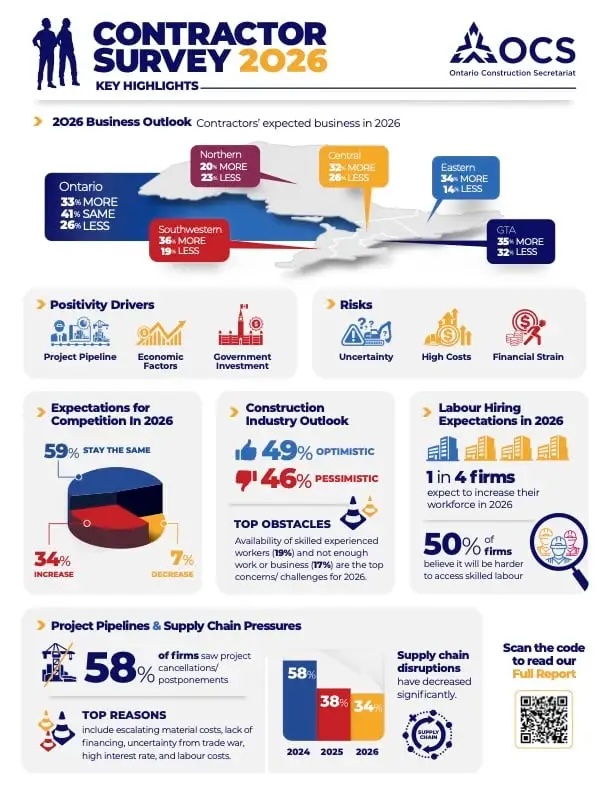
The survey, conducted by Ipsos, reveals that two-thirds of contractors reported operating at or above capacity in 2025, with a similar proportion expecting that trend to hold through 2026. This stability comes despite a marketplace that appears deeply divided: 49 per cent of respondents expect the overall market to remain stable or grow, while 46 per cent anticipate a decline.
“Ontario’s ICI contractors continue to show remarkable strength and adaptability in a time that is dominated by uncertainty,” OCS CEO Brian Barron said in a statement.
Project delays and cost pressures
While firms remain busy, the survey highlighted significant hurdles. More than half of contractors (58 per cent) reported that at least one project had been delayed or cancelled over the past year.
Respondents cited four primary drivers behind these deferments:
- Escalating material costs: 66 per cent
- Lack of financing: 59 per cent
- Trade war uncertainty: 45 per cent
- High interest rates: 45 per cent
Despite these financial pressures, there is a silver lining in the supply chain. Only one-third of contractors reported supply chain disruptions in the past year, a sharp decrease from the 58 per cent reported in 2024.
Regional outlooks
Confidence levels vary across the province. Contractors in the Southwest (36 per cent), Greater Toronto Area (35 per cent), East (34 per cent), and Central Ontario (32 per cent) are generally bullish, expecting growth in 2026.
However, the outlook in Northern Ontario is notably more cautious, with only 20 per cent of businesses forecasting growth. The OCS noted that in smaller markets like the North, a single large-scale project can dramatically shift labour requirements and market dynamics.
The labour and apprenticeship gap
Labour market imbalances remain a top-tier concern, cited by one-in-five contractors as their primary challenge. As the “Baby Boomer” generation continues to retire, the industry is doubling down on recruitment.
The survey found that 70 per cent of contractors now employ apprentices, up from 64 per cent in 2025 and 58 per cent in 2024. The commitment is particularly strong among unionized firms, where 82 per cent are currently training apprentices.
“It is clear that our labour and management partners are committed to training the next generation of skilled tradespeople,” Barron said. “But there remains a cautious undertone. While we are making progress, there is a need for stability in the sector, project certainty, and policy support.”
Survey methodology
The OCS Contractor Survey polled a representative sample of 400 union and non-union ICI contractors via phone interviews between Dec. 23, 2025, and Jan. 26, 2026. The results carry a margin of error of +/- 4.9 per cent, 19 times out of 20.
The full report is available at iciconstruction.com.