

Ontario Construction Report staff writer
A new review of construction worker fatalities in Ontario has identified systemic health and safety concerns and issued 14 recommendations aimed at preventing future workplace deaths.
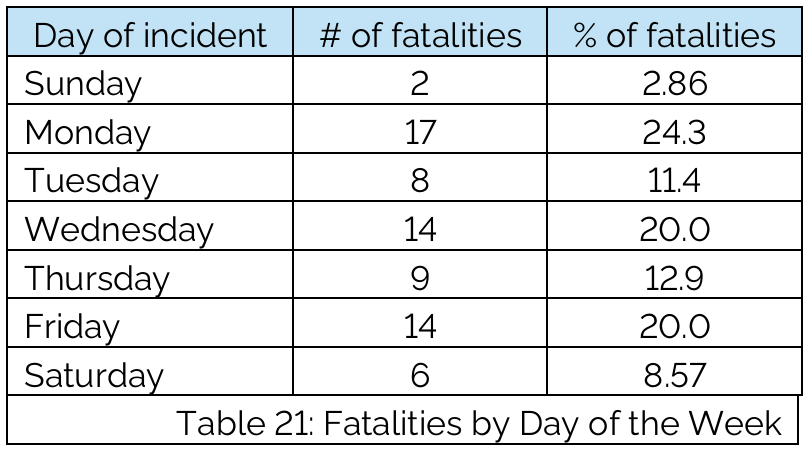
It reviews 43 construction-related deaths in Ontario that occurred between 2015-2023 and one death that occurred in 1994. Forty-two deaths in this report occurred as a result of an interaction with the following five hazards: • Heavy Material or Equipment Hazard • Crushing • Walls, Ceilings or Trench Collapse • Electrical Exposure • Elemental Exposure The committee also considered the deaths of two workers who died many years after an incident from consequences incurred as a result of an injury.
The second annual report from the Construction Death Review examined the deaths of 44 construction workers in incidents unrelated to falls from heights. The fatalities occurred primarily between 2015 and 2023 and involved hazards including heavy materials and equipment, trench collapses and electrical exposure.
Recurring issues relate to workplace health and safety culture, particularly worker experience and inexperience, as well as the use—or lack of use—of manufacturers’ operating instructions for vehicles, machinery and equipment.
Based on its findings, the review made 14 recommendations to the Ministry of Labour, Immigration, Training and Skills Development, the Infrastructure Health and Safety Association and other provincial health and safety partners.
Recommendations include:
- Reviewing the compatibility of formwork systems that are commonly used in Ontario.
- Consulting with industry about enhancing and/or clarifying regulations regarding solar photovoltaic work and associated electrical safety hazards.
- Publishing a health and safety advisory about the hazards of working on or near water.
- Working with local groups to distribute that advisory to constructors and employers.
- Enhancing supervisor awareness training requirements in O. Reg. 297/13.
- Analyzing MLITSD data relating to non-compliance with subsections 93 (3) and/or 93 (4) of O. Reg. 213/91—regarding using all vehicles, machines, and equipment in accordance with their operating manuals—that resulted in a critical injury or fatality.
- Developing an educational campaign on the importance of working in accordance with manufacturer’s operating manuals and/or instructions.
- Reviewing section 43 of the Occupational Health and Safety Actwith a focus on identifying barriers that may impede construction workers from exercising their right to refuse unsafe work.
- Creating a stakeholder-informed plan to address those barriers and obstacles.
- Making the results of the above review (i.e., Recommendation no. 8) publicly available.
- Enhancing the requirements of a “competent person” and “competent worker” specific to work involving drill rig operation, rigging and hoisting, signalling for mobile equipment, demolition, and excavation and trenching.
- Drawing on MLITSD data and consultation with relevant stakeholders to inform Recommendation no. 11.
- Developing guidelines and performance indicators to better define the skills, experience, and training needed to be a “competent person” and “competent worker.”
- Exploring opportunities to expand formal assessments of workplace health and safety programs for employers that experience more than one worker fatality, high numbers of critical injuries, and/or longer durations of lost time within a five-year period.
The Construction Death Review’s first annual report focused on fatalities resulting from falls from heights. The second report broadens the review to other leading causes of fatal injuries in Ontario’s construction sector.