

Ontario Construction Report staff writer
The federal government has introduced legislation that would overhaul the approval process for major infrastructure and energy projects, including setting a one-year target for federal reviews and allowing limited preparatory construction to begin before all federal approvals are in place.
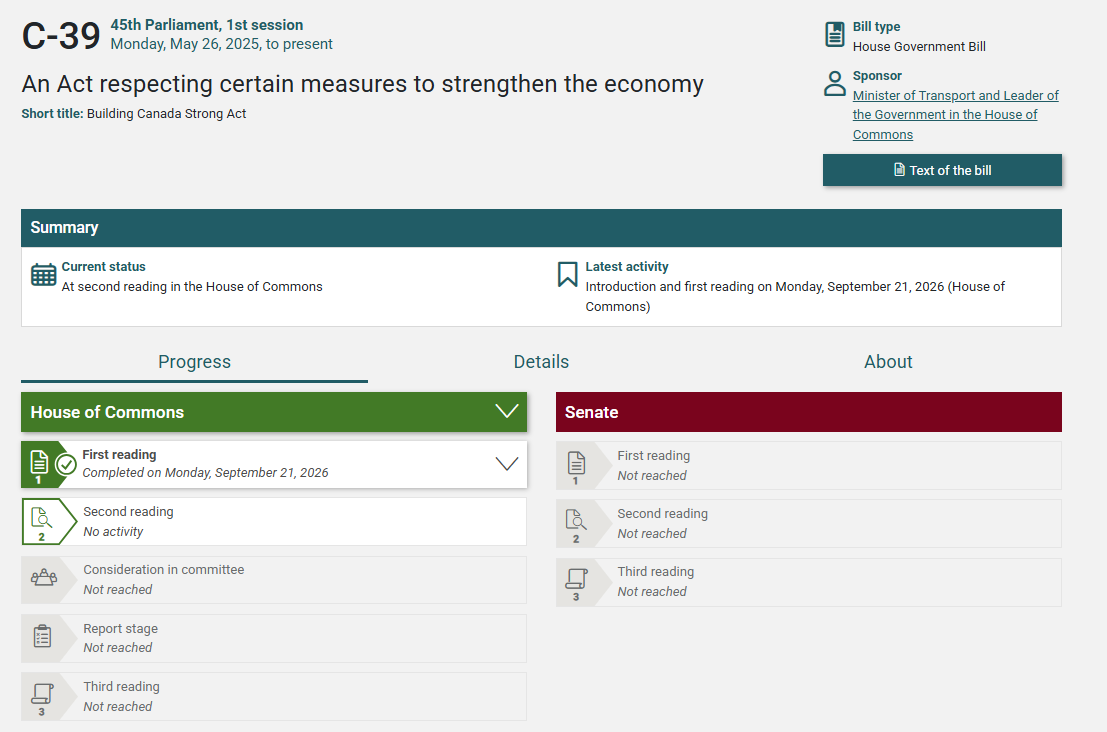
Bill C-39, the Building Canada Strong Act, was tabled Monday by Prime Minister Mark Carney’s government as part of its plan to accelerate major projects and reduce delays in getting them from the planning stage to construction.
The proposed changes could affect contractors, project owners and other companies involved in major transportation, energy, pipeline, transmission and nuclear projects.
The legislation would establish a one-year timeline for federal reviews and decisions once a project proponent has submitted a complete application and the required studies and information. The government says the changes are intended to reduce duplication between federal assessments and permitting processes.
Transport Minister Steven MacKinnon said the changes are intended to make it easier to get infrastructure built.
“This legislation will give our country the tools we need to build more, better and more efficiently,” MacKinnon said Monday.
The bill would also create “regions of national interest” through regional impact assessments. Projects within those areas could receive special treatment under federal legislation.
The government is proposing a “one window” approach for some major projects, with a single federal agency or regulator coordinating assessments and permits.
The Canada Energy Regulator would take responsibility for assessments of international and interprovincial pipelines, transmission lines and offshore renewable energy projects, while the Canadian Nuclear Safety Commission would handle nuclear and uranium projects.
The legislation would also allow the environment minister, in certain circumstances, to authorize preparatory work before a final impact assessment decision. The work would be subject to conditions and would not guarantee approval of the overall project.
For the construction industry, the changes could mean greater certainty around project schedules if federal reviews and permitting are completed within the proposed timelines. The government says some projects have waited more than five years for the federal decisions required before construction can begin.
The government says environmental standards and Indigenous consultation requirements would remain in place.
Opposition parties and environmental groups have questioned whether faster reviews could reduce scrutiny of major projects.
Bloc Québécois Leader Yves-François Blanchet said the legislation risks making Canada more attractive to large foreign companies by reducing regulatory requirements.
“I fear that it is one more token placed on the table in order to attract huge foreign businesses in Canada, telling them that there will be no more environmental regulations, much less work regulations, and that things will be easy. We even promise to you that within one year the table is clear. Go ahead,” Blanchet said Monday.
The government has rejected the suggestion that the changes would eliminate environmental protections. It says the legislation is intended to reduce duplication and speed up reviews while maintaining environmental standards and Indigenous rights.
Bill C-39 also proposes changes to federal labour rules, including earlier collective bargaining in certain circumstances, federally mediated “relationship repair” following work stoppages and increased enforcement and penalties for bad-faith bargaining.
The legislation would maintain provisions allowing the federal labour minister to direct the Canada Industrial Relations Board to order workers back to work and refer disputes to binding arbitration in circumstances where the minister determines it is in the national interest.
A proposed 21-day mediation process would also give a special mediator time to examine the bargaining positions of both sides and make recommendations before the government considers further action.
The government says the labour changes are intended to help prevent disputes from escalating while maintaining the right to strike.
The legislation follows consultations held over the summer on proposed changes to Canada’s project approval and labour systems. The government said it received more than 21,000 emails during the consultation process.
Bill C-39 must go through the parliamentary process before the proposed changes become law.