

Northern Ontario Construction News staff writer
Ontario’s residential construction investment is expected to slow through 2027 before recovering significantly through 2029, while non-residential activity is forecast to remain elevated as major projects drive demand across the province.
BuildForce Canada’s latest Construction and Maintenance Looking Forward report predicts Canadian construction investment increasing in 2025, with further growth in the non-residential sector supplementing an increase in residential investment driven by higher housing starts.
“Construction is a key contributor to Canada’s economic output, accounting for 7% of our national gross domestic product and employing 1.6 million people, or about one in every 13 working Canadians,” says Warren Douglas, Chair of BuildForce Canada. “As construction is increasingly called upon to deliver on public policy initiatives and to sustain Canada’s exceptional quality of life, the industry must continue to promote itself as a first-choice career option for young people and people from under-represented groups if it is to refresh its labour force and continue to deliver essential infrastructure.”
In Ontario, however, residential construction is expected to face significant challenges, with demand for new housing constrained by lower immigration levels and a surplus of unsold units.
BuildForce Canada forecasts residential investment to slow into 2027 before recovering significantly through the end of the decade. Growth in later years is expected to be driven by strong levels of new construction in both single-detached and multi-unit dwellings.
Ontario’s non-residential construction sector presents a stronger outlook.
Investment is expected to continue being driven by a long list of major projects in engineering construction and institutional, commercial and industrial (ICI) building construction.
Strong demand for non-residential maintenance activities is also expected to contribute to growth, with the combined activity forecast to push non-residential investment to a peak in 2029 and sustain elevated levels into the early 2030s.
Nationally, BuildForce expects non-residential construction activity to rise through 2029, supported by major transit, utility, mining and critical mineral projects, as well as federal nation-building projects. Healthcare and education projects are also expected to support ICI construction, while commercial building activity is projected to grow in later years.
Non-residential investment is expected to slow in later years as major projects reach peak activity or are completed, but maintenance of the existing non-residential building stock is forecast to increase significantly through the end of the decade.
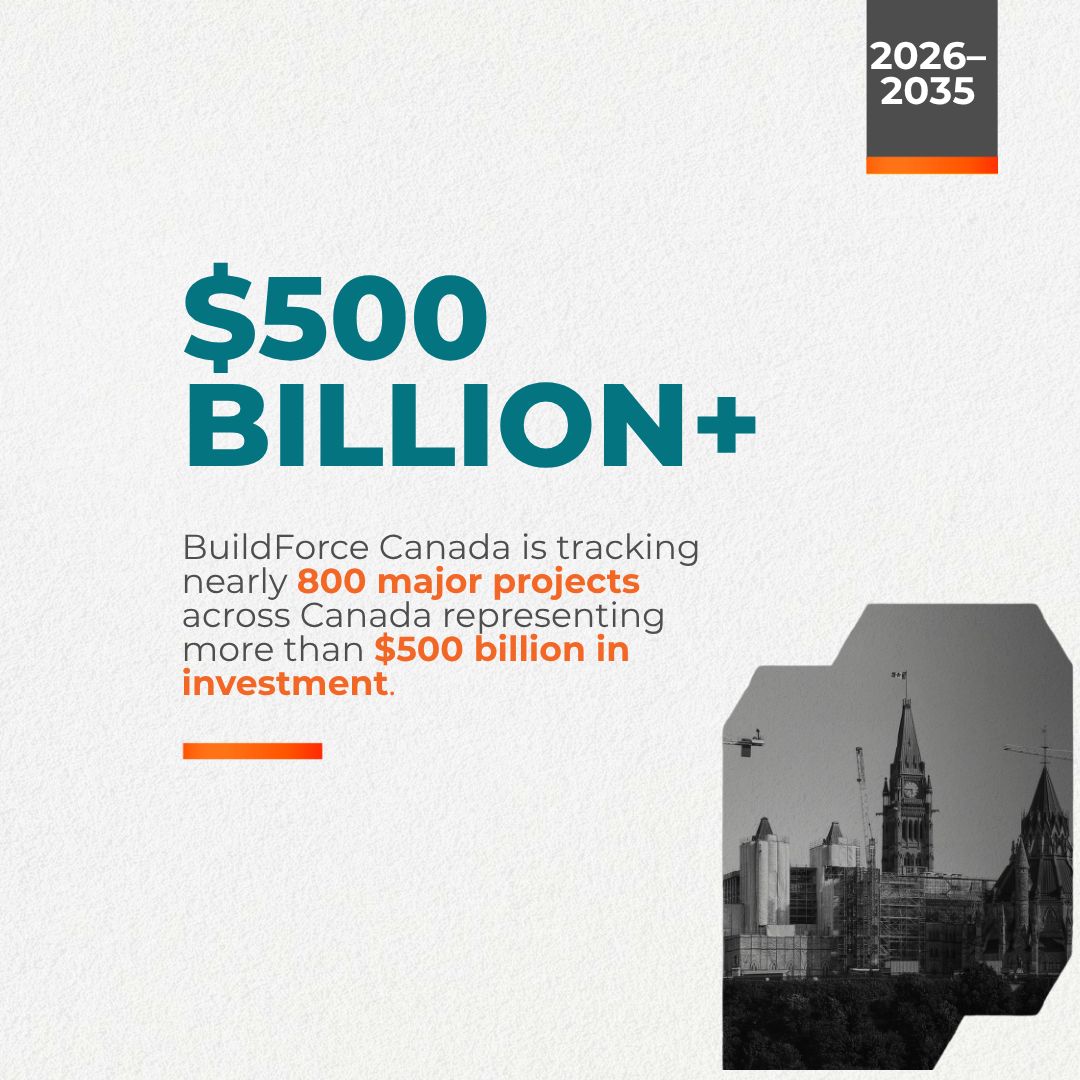
BuildForce is currently tracking nearly 800 major projects across Canada with a combined value of more than $500 billion. The organization also said a long list of projects that have not yet reached final investment decisions has not been included in its forecast scenario.
They could significantly affect investment and employment growth if approved, said Irwin Bess, executive director of BuildForce Canada.
The construction outlook also highlights labour market pressures facing the industry.
Across Canada, labour pressures in the residential sector remained elevated in 2025 across many of the 34 trades and occupations tracked by BuildForce. Those pressures are expected to ease as residential demand declines in the early forecast years, with some trades potentially facing labour force surpluses.
Non-residential labour markets are expected to remain tight in many provinces and regions, with demand closely tied to the timing of major projects.
BuildForce said the construction industry must continue recruiting and retaining workers as the workforce ages and demand for construction grows.
Nationally, construction accounts for about 7 per cent of Canada’s gross domestic product and employs 1.6 million people, or approximately one in every 13 working Canadians, according to BuildForce.
Construction investment is expected to follow different paths across the rest of Canada.
Atlantic Canada:
- residential investment is forecast to contract in all four provinces through the end of the decade
- non-residential activity is expected to be supported by major projects, with Newfoundland and Labrador reaching a projected peak in 2031, Nova Scotia in 2029 and New Brunswick in 2027. Prince Edward Island is expected to see investment decline after a 2026 peak before a modest recovery later in the forecast period
Quebec:
- residential investment is expected to decline from elevated 2025 levels, reaching a low in 2029 as new housing activity slows
- growth later in the period is expected to be driven primarily by renovations. Non-residential investment is forecast to rise into 2027 before fluctuating with the timing of major projects
Manitoba:
- residential construction is projected to grow through 2035, with renovations initially offsetting weaker new-home demand before both components return to growth after 2029
- non-residential investment is expected to peak in 2030, supported initially by major engineering projects and later by ICI construction.
Saskatchewan
- forecast to see strong growth in residential investment throughout the period, led by new-home construction and supported by renovations
- non-residential investment is expected to remain relatively stable, with fluctuations tied to major projects
Alberta
- residential investment is expected to peak in 2026 before contracting through the end of the decade
- new housing demand is expected to be constrained by lower international migration and later by slower multi-unit construction
- non-residential buildings investment, however, is forecast to grow moderately, with gains in engineering, ICI construction and maintenance
British Columbia
- expected to see contractions in both residential and non-residential investment. Residential activity is forecast to decline through 2028 before stabilizing, with multi-unit construction particularly affected
- non-residential investment is expected to reach a historic peak in 2027 as major engineering projects, including four federal nation-building projects in the northern region, reach completion, before slowing through 2032